

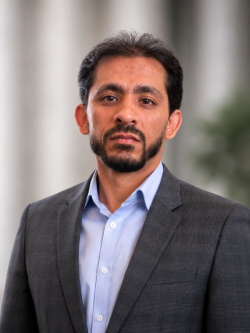

Dr. Omar Joya is a co-founder of Biruni Institute and served as its Executive Director from 2021 to 2023. An economist with more than a decade of experience across international institutions, the Afghan government and academia, he served for more than five years as the World Bank’s Country Economist for Afghanistan, based in Kabul and Washington, D.C., and earlier worked at Da Afghanistan Bank and the Afghanistan Investment Support Agency.
His research spans econometric modelling, macro-fiscal analysis and economic development, and he has published in peer-reviewed journals including the European Economic Review, Economics of Transition and Structural Change and Economic Dynamics. At the Institute, he developed the SAM-based multiplier model for Afghanistan and co-authored its flagship study, Cost of Non-Cooperation Between South and Central Asia. He also oversees quality assurance across Biruni’s research and advisory work, holding it to international peer-review standards.
Dr. Joya was an Assistant Professor of Economics at the American University of Afghanistan for over three years and has lectured at the University of Paris. He was a researcher at the Bordeaux School of Economics (GREThA, CNRS 5113) and was a Visiting Research Fellow at the Oxford Centre for Islamic Studies, University of Oxford, in 2019–2020. He holds a PhD in Economics from the University of Bordeaux.
Education
Ph.D. Economics, University of Bordeaux, France, 2017.
M.Sc. Development Economics, University of Bordeaux, 2011.
M.Sc. Economic Policy & Analysis, University of Strasbourg, 2010.
B.Sc. Economics, University of Strasbourg, 2008.
Google Scholar Profile:
https://scholar.google.com/citations?user=ch6-kBAAAAAJ
Selected Publications
Peer-reviewed academic articles:
- “Do (all) sectoral shocks lead to aggregate volatility? Empirics from a production network perspective.” Co-authored with Eric Rougier. European Economic Review. Vol. 13: 77-107. DOI: 10.1016/j.euroecorev.2019.01.004
- “How should resource-rich countries diversify? Estimating forward-linkage effects of mining on productivity growth.” Economics of Transition and Institutional Change. Vol. 27 (2): 457-473. DOI: 10.1111/ecot.12191
- “Growth and volatility in resource-rich countries: Does diversification help?” Structural Change and Economic Dynamics. Vol. 35: 38-55. DOI: 10.1016/j.strueco.2015.10.001
Analytical reports/ Policy papers:
- “Understanding the Drivers of Poverty in Afghanistan.” Co-authored with Eric Rougier and Saurabh Shome. Biruni Institute. Forthcoming (April 2022).
- “Cost of non-cooperation between South and Central Asia: Trade benefits, challenges, and opportunities.” Co-authored with Lutfi Rahimi and Sebnem Sehin. Biruni Institute. August 2021.
- “Effectiveness of Development Assistance in Afghanistan: Lessons from World Bank Experience.” Co-authored with Khalid Payenda. Biruni Institute. May 2021.
- “Theoretical and legal framework of Islamic economics (in Persian).“ Biruni Institute. March 2021.
- “Afghanistan to 2030: Priorities for economic development under fragility.” Co-authored with Claudia Nassif and Tobias Haque. The World Bank. August 2018.
- “Urgency of Fiscal Stability” in Faruk Khan (editor) “Afghanistan: Systematic Country Diagnostic.” The World Bank. February 2016.
- “Afghanistan: Pathways to Inclusive Growth.” Co-authored with a group of authors led by Claudia Nassif. The World Bank. March 2014.
- “Afghanistan Development Update” series (between April 2013 and Nov 2017). Bi-annual reports released by The World Bank. Lead author. As part of Focus Sections in each edition, I authored the following pieces:
- “Estimating Revenue Potential in Afghanistan” in Omar Joya (editor) “Afghanistan Development Update: April 2016” The World Bank.
- “Outcomes from Brussels: What are Afghanistan’s long-term fiscal sustainability prospects?” in Omar Joya (editor) “Afghanistan Development Update: October 2016” The World Bank.
- “How to provide economic stimulus in a resource-constrained environment” in Omar Joya (editor) “Afghanistan Development Update: Spring 2017” The World Bank.
- “Natural Resources: What Strategy for Afghanistan?” Policy Paper. Samuel Hall Consulting. January 2013. Also published by the Afghan Institute for Strategic Studies.
Consultancy reports/ Working papers:
- “Macroeconomic effects of promoting domestic production in Afghanistan.” Paper produced for Ministry of Economy under The World Bank consultancy. May 2018
- “Sustaining the working poor in Kabul informal settlements: An evaluation of Solidarités International’s vocational training programme.” with Nassim Majidi. Samuel Hall Consulting. November 2012.
- “MODAF: A small macroeconom(etr)ic model of the Afghan economy.” Monetary Policy Department. Central Bank of Afghanistan. June 2009
Non-academic articles:
- “Can Afghanistan Return to Its Pre-2014 Boom Time?” The Diplomat. March 28, 2018.
Programming: Matlab / Octave add-on codes:
- “Date converter across Gregorian, Persian, and Islamic calendars”, Published on May 4, 2018 in MATLAB Central File Exchange.