

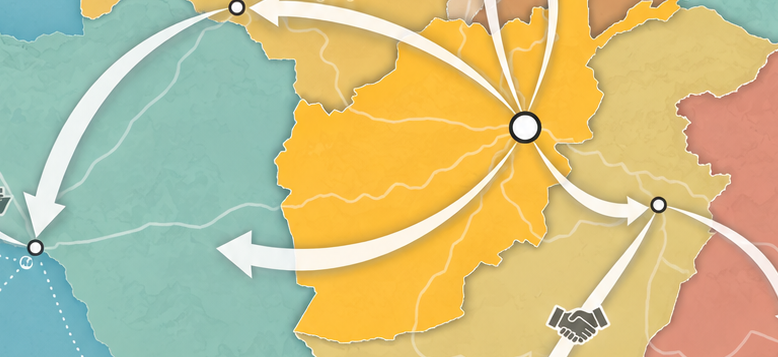

This study asks a simple question: what is the economic cost of limited cooperation between South and Central Asia, and why have countries struggled to realise the potential gains from greater integration? The analysis covers Afghanistan, India and Pakistan, together with Kazakhstan, the Kyrgyz Republic, Tajikistan, Turkmenistan and Uzbekistan. Afghanistan is central to the study because of its long-standing ambition to become a trading hub between the two regions.
The study combines quantitative modelling with political economy analysis. A GTAP computable general equilibrium (CGE) model is used to simulate three scenarios: tariff removal, tariff plus non-tariff measure reform, and a third scenario that also assumes a substantial increase in India-Pakistan trade. For Afghanistan, the sectoral results are linked to an Afghanistan Social Accounting Matrix (A-SAM) multiplier model to estimate household income and poverty effects. Employment effects are also estimated, while expert semi-structured interviews are used to examine why economically beneficial reforms have often proved difficult to implement.
Start with the GDP results. Under Scenario 1, real GDP is 5.79 percentage points above the baseline in Afghanistan and 5.98 percentage points above it in the Kyrgyz Republic. When NTM reform is added under Scenario 2, these effects rise to 6.73 and 6.43 percentage points, respectively. Under Scenario 3, the effects are largest in Afghanistan (+9.50 percentage points), the Kyrgyz Republic (+7.66) and Pakistan (+5.70). The effects are smaller in Tajikistan (+2.59), India (+2.39), Kazakhstan (+0.50) and Turkmenistan-Uzbekistan (+0.36). These are conditional simulation effects relative to the baseline average growth rates between 2021 – 2025, not forecasts of annual growth.
The employment and poverty effects are also sizeable. Under Scenario 3, the model implies around 12.4 million more employed people relative to the baseline, including about 8.0 million in India, 3.5 million in Pakistan and 0.73 million in Afghanistan. This is a difference in employment levels, not 12.4 million jobs created each year. For Afghanistan, the poverty rate falls from 54.5% to 50.4%, a reduction of about 4.1 percentage points, equivalent to roughly 1.3 million fewer people living below the poverty line using the population estimate applied in the analysis.
Not all effects increase as the scenarios become more comprehensive. India’s GDP and export effects are slightly lower under Scenario 2 than Scenario 1. Real factor-income effects under Scenario 3 are also lower than under Scenario 2 in Afghanistan, India, the Kyrgyz Republic and Tajikistan, while the Kyrgyz Republic’s employment effect falls. The important point is that larger GDP or export gains do not automatically translate into equally large gains in factor income or employment. The model captures changes in relative prices, sectoral composition and resource allocation, but the available outputs do not allow each of these movements to be attributed to a single mechanism.
What, then, prevents countries from realising these gains? The interviews point to a connected set of constraints. Political and security objectives frequently override economic ones. Border rules, customs procedures, visa requirements and other administrative processes raise the cost and uncertainty of doing business. Infrastructure remains incomplete, while large regional projects face financing, coordination and implementation problems. Regional cooperation is also still heavily centred on governments, with limited participation by firms, traders and other non-state actors.
The interviews do not suggest waiting until all of these constraints disappear. The policy direction is more incremental. Afghanistan needs clearer institutional responsibility for regional economic policy, more predictable border and commercial administration, economically justified transport investment and stronger market participation. At regional level, countries should protect economic channels during periods of political tension, pursue deliverable bilateral and sub-regional initiatives alongside larger projects, and involve market actors more systematically.
The overall conclusion is not that integration is automatic, or that all barriers should simply be removed. It is that the economic gains from greater cooperation could be substantial, but realising them depends on institutions, implementation and political incentives as much as on geography or trade policy itself.